
Insights › Generational Wealth
Preparing Heirs for Inherited Wealth: The Conversation That Saves Generations
Two out of three wealthy families lose their wealth by the second generation. The fix isn't a better trust — it's a family willing to have the conversations most families avoid.
The data is older than most advisors realize. The Williams Group study of more than 3,000 wealthy families found that 70% lost their wealth by the second generation and 90% by the third. The pattern holds across regions, industries, and structures.
The cause was almost never investment performance, tax law, or even spending. It was a breakdown of communication and trust inside the family.
The trust documents were beautifully drafted. The conversations never happened.
What "preparing heirs" actually means
Preparing heirs is not handing them a balance sheet at age 25 and hoping for the best. It is a multi-year process that runs in parallel with the estate plan, not after it. It involves:
- Financial literacy appropriate to the age and stage of each heir
- Exposure to the family's values, history, and intentions around the wealth
- Progressive responsibility — small decisions first, larger decisions later
- Honest conversations about what they will and will not receive
- A governance structure that survives the founders
This is uncomfortable work. It is also the single highest-leverage thing affluent families can do.
The four ages of financial education
We organize family education by life stage:
Ages 8-15: foundational concepts
- Earning, saving, spending, giving as four distinct categories
- The difference between needs and wants
- Compound growth, demonstrated with small accounts
- The family's giving traditions
Ages 16-22: practical tools
- How a checking account, credit card, and credit score actually work
- The basics of taxes — the first paycheck moment
- Investing fundamentals: stocks, bonds, mutual funds, index funds
- An introduction to the family's structures, at the appropriate level of detail
Ages 23-35: stewardship
- Reading a personal balance sheet and income statement
- Understanding trusts: what a beneficiary, trustee, and grantor each do
- The family business or investment philosophy
- Participation in giving decisions, starting small
Ages 35+: leadership
- Full transparency on the family's financial picture
- Trustee or co-trustee roles where appropriate
- Investment committee participation
- Mentorship of the next generation
The family meeting
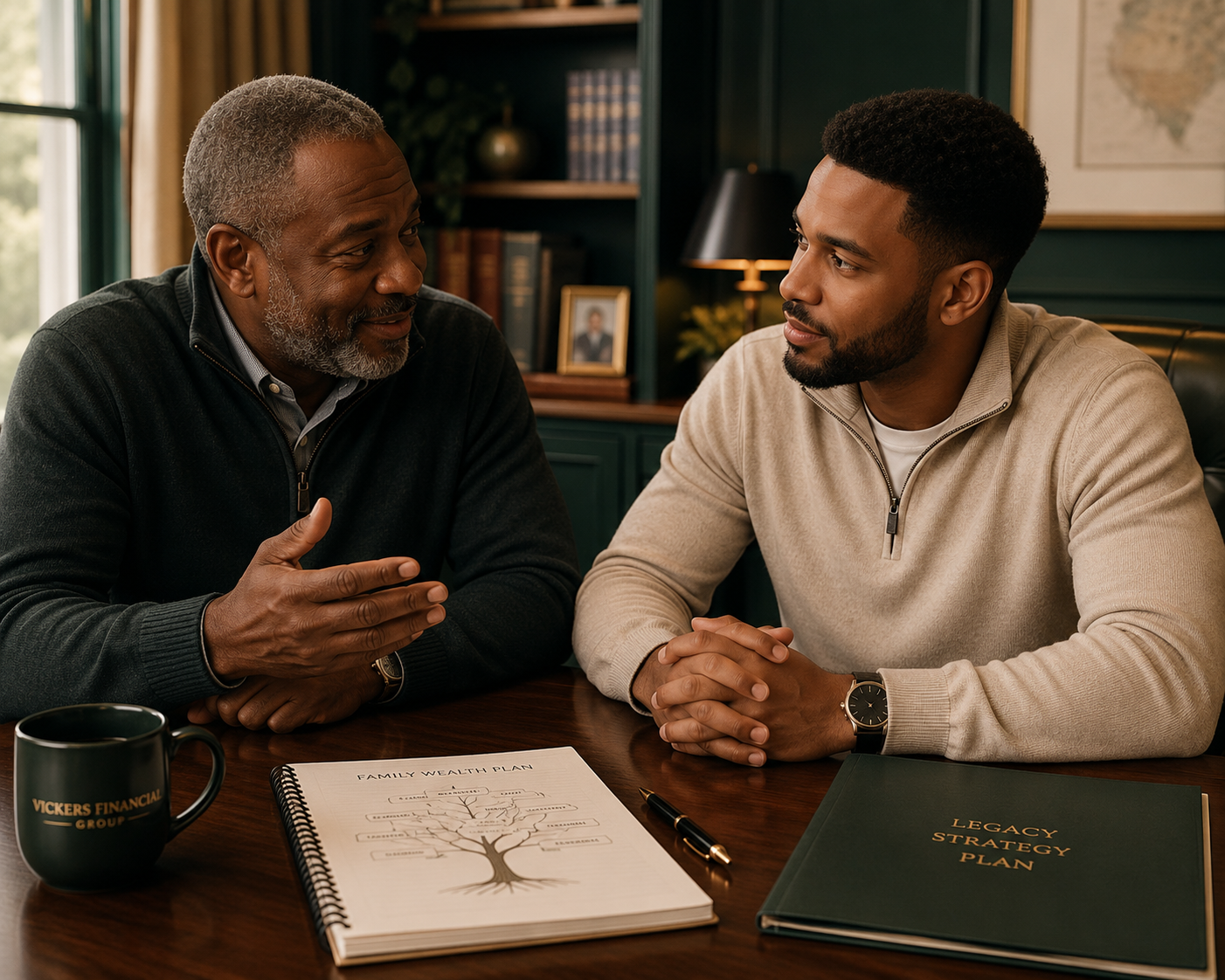
The single highest-impact practice we see is an annual family meeting. Not a holiday dinner. A scheduled, agenda-driven meeting with adult family members, ideally facilitated.
A typical agenda:
- Review of the family balance sheet at a level of detail appropriate to attendees
- Review of the year's significant decisions (gifting, charitable, business)
- Discussion of any structural changes (new trust, business event, etc.)
- Family mission and values check-in
- Open Q&A
- Plans for the coming year
The meeting is held in person where possible, lasts a half-day to a full day, and includes a meal. Many families bring in their advisor team for the morning and reserve the afternoon for family-only conversation.
The family mission
Most affluent families have never written down what the wealth is for. Without that statement, every decision is ad hoc and the next generation inherits cash without context.
A family mission is one or two paragraphs that answers:
- What is the wealth for?
- What values guide how we use it?
- What do we hope it makes possible — for our family, our community, our work?
It is not a contract. It is a compass. Families that have one make decisions faster and disagree less.
Trust structure that supports the work
The legal documents should reinforce the education, not contradict it. Practical features we use:
- Staged distributions that release principal at ages tied to demonstrated capability (often 30, 35, 40), not arbitrary dates
- Incentive provisions that match earned income, fund education, or support entrepreneurship
- Independent trustees who can say no without damaging family relationships
- Trust protectors who can adjust terms as circumstances change
- HEMS standards (health, education, maintenance, support) for discretionary distributions
These are not punitive. They are scaffolding.
The hardest conversations
The conversations most families avoid:
- "Here is what you will inherit, and here is what we expect of you."
- "Here is what your sibling will inherit, and here is why it is different."
- "Here is what we are giving to charity, and why."
- "Here is what happens if one of you needs more than the others."
- "Here is what we are not telling you yet, and why."
There is no playbook that makes these easy. There is only the willingness to have them while everyone is healthy and in the room.
What we do
We work with families on the legal structures, the investment strategy, and the tax planning. Increasingly, the most valuable work we do is convening the family meeting, building the education curriculum, and facilitating the conversations the family has been postponing.
The trust will not save the family. The family will save the family — if it has the structures, the education, and the conversations in place.
If yours hasn't, that is the place to start.
Frequently Asked
Common Questions
When should I tell my children what they will inherit?+
Most families benefit from progressive disclosure starting in the early twenties — broad strokes first, more detail as adult children demonstrate maturity. Full transparency typically lands in the thirties. Surprise inheritances are rarely well-handled.
What is a family mission statement?+
A short written document — usually one or two paragraphs — that captures what the family's wealth is for, the values that guide its use, and what the family hopes it makes possible. It serves as a decision-making compass across generations.
Should we have an annual family meeting?+
Yes. Families that hold a structured annual meeting with adult members, an agenda, and outside facilitation when helpful consistently outperform families that rely on informal conversations. The cadence matters more than the perfection of any single meeting.